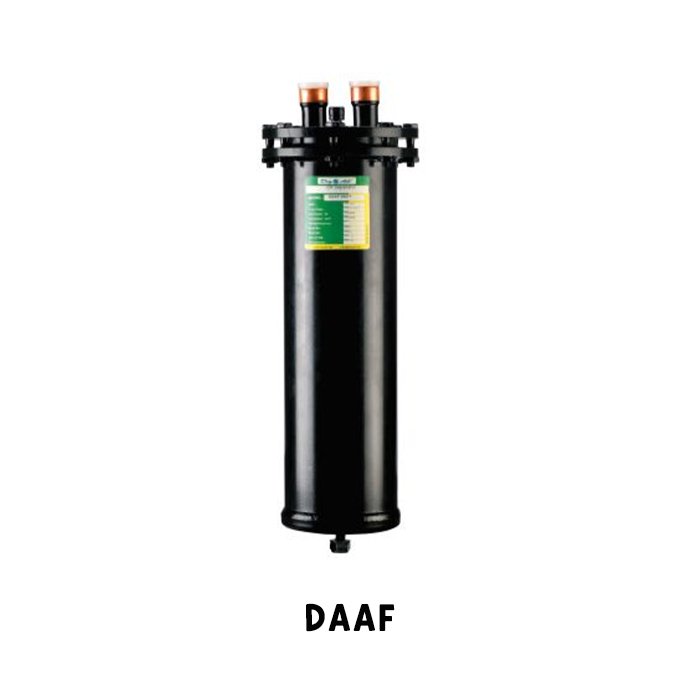
Liquid Refrigerant Receivers Vertical

Oil Separators (DAHW & DAAF)

Dry All Oil Separators designed to perform the following task


Recommended For: Multiple compressor racks for supermarkets and air conditioning, Systems with long refrigerant lines, Systems with inherent oil return problems, Ultra-low temperature systems.

  • Description
  • Key Featuers
  • Drawing & Models Table
  • Data Sheet

Dry All Oil Separators designed to perform the following task


Recommended For: Multiple compressor racks for supermarkets and air conditioning, Systems with long refrigerant lines, Systems with inherent oil return problems, Ultra-low temperature systems.


  • Removing Oil from Discharge Line Leads to Improvement in efficiency
  • Maintain Oil Level in Compressor to Prevent Breakdown
  • Reduce Noise and Pulsation at Discharge Side

    Unique Construction
  •   Only Company to Offer Choices –

  •   Accessible Bolted Flange Type: Ease of Installation

  •   Hermetic Welded Connection type: No Site Abuse

  •   Nylock Nut Bolt Type Mounting.

  •   Optimally Designed to Minimize Pressure Drop

  • Dry All Oil Separator Has Up To 95% Efficiency
  • Using Demister Pads, VRF Specific Oil Separators Have 95% Oil Separation Capability.

  • Highly Efficient & Energy Saving

  • Dry All Oil Separators Have 20% Higher Filter Pocket Area
  • Ensures Superior Oil & Refrigerant Separation
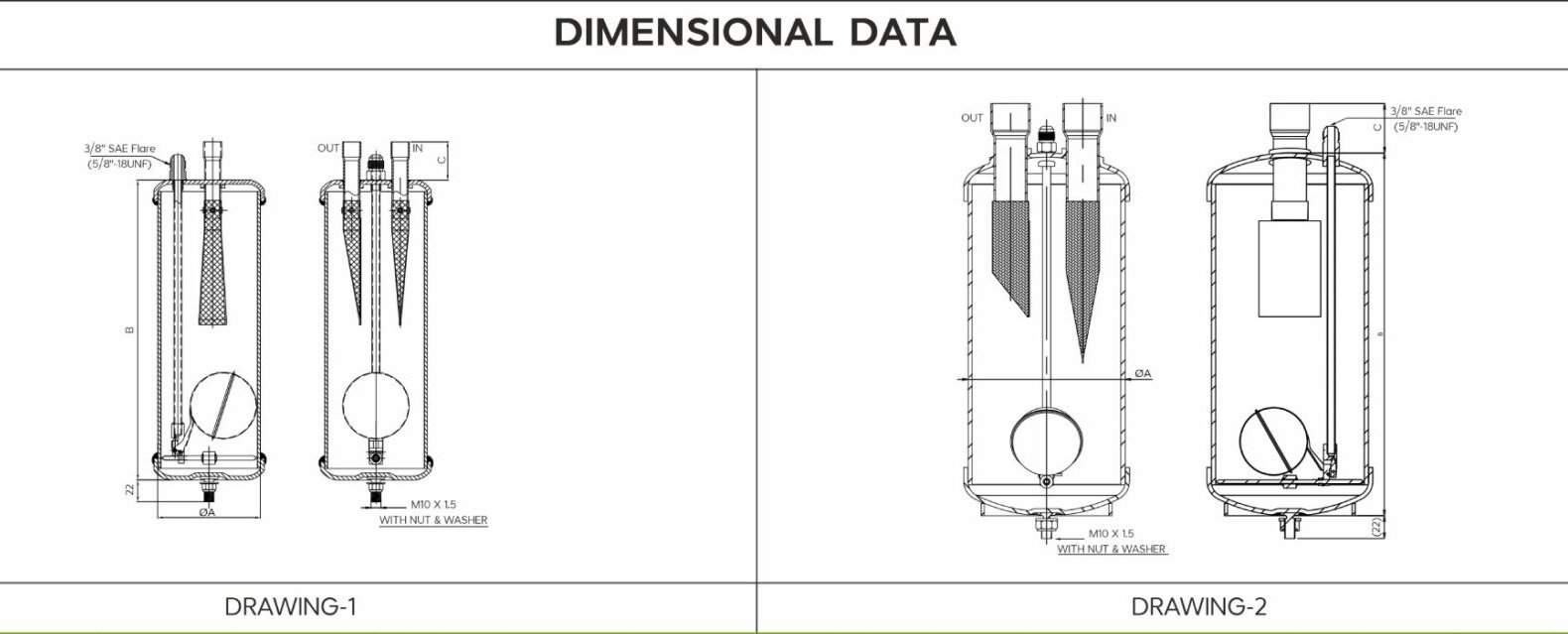
DIMENSIONAL DATA
Sr. No. Model Connection Size
In & Out
Oil Return Connection Dimension Mounting Option Oil Charge Amount Refer Drawing No.
ØA mm ØA Inch B mm B Inch C mm C Inch D mm D Inch
HERMETIC WELDED TYPE
1 DAHW-5582-3S 3/8" ODF 3/8" SAE* 101.6 4 160 6.30 26 1.00 NA NA M10 X 1.5 BOLT WITH WASHER & NUT 500 ml 1
2 DAHW-5582-4S 1/2" ODF 250 9.80 37
3 DAHW-5585-5S 5/8" ODF 297 11.70 38 1.50
4 DAHW-5587-7S 7/8" ODF 344 13.50 37
5 DAHW-5588-9S 1-1/8" ODF 375 14.80 37
6 DAHW-5590-11S 1-3/8" ODF 451 17.80 46.5 1.80
7 DAHW-5690-11S 1-3/8" ODF 152.4 6 352 13.90 48 1.90 1250 ml 2
8 DAHW-5692-13S 1-5/8" ODF 430 16.90 59 2.30
9 DAHW-5694-17S *2-1/8" ODF 50 2.00
HERMETIC WELDED TYPE - CE
1 DAHW-5585-5S 5/8" ODF 3/8" SAE* 101.6 4 297 11.70 38 1.50 NA NA M10 X 1.5 BOLT WITH WASHER & NUT 500 ml 2
DIMENSIONAL DATA
Sr. No. Model Connection Size
In & Out
Oil Return Connection Dimension Mounting Option Oil Charge Amount Refer Drawing No.
ØA mm ØA Inch B mm B Inch C mm C Inch D mm D Inch
ACCESSIBLE BOLTED FLANGE TYPE
1 DAAF-5885-5S 5/8" ODF 3/8" SAE* 101.6 4 335 13.19 35 1.38 142 5.59 M10 X 1.5 BOLT WITH WASHER & NUT 500 ml 1
2 DAAF-5858-7S 7/8" ODF 101.6 4 416 16.38 40 1.57 142 5.59
3 DAAF-5888-9S 1-1/8" ODF 101.6 4 498 19.6 42 1.65 142 5.59
4 DAAF-5890-11S 1-3/8" ODF 1/4" SAE* 101.6 4 478 18.82 42 1.65 142 5.59

Liquid Receiver - Installation Guideline

FAQ – ‘Dry All’ Oil Separators

Why an Oil Separator is required in HVAC&R System?

During functioning of the compressor, some amount of oil in the crank-case of the compressor will also boil off along with the refrigerant and escape the compressor. If this oil is not returned back to the compressor, the compressor will cease due to lack of lubricating oil.


Secondly circulating oil in the system will form a coating on the system components and affect heat transfer and hence reducing the efficiency of the system.

The oil which has escaped needs to be returned back to the compressor with the help of an Oil Separator.

How does an Oil Separator work and serve the purpose?

Oil separators separates oil from the hot vapour refrigerant in the discharge line, temporarily store the oil, and then return it back to the compressor crankcase or to the oil reservoir in multiple compressor systems, thus assuring an efficient lubrication of compressors moving parts.

When mixture of refrigerant and oil enters the Oil Separator inlet, the same passes through a fine steel mesh filter pocket. This disturbs the mixture and because of their individual properties they separate. Oil being heavy drops to the bottom. Refrigerant because of the vessel volume of Oil Separator will vaporize and will leave through the outlet pocket. Here too there is a fine steel mesh filter pocket which further stops the oil from leaving the Oil Separator.

How is the collected oil returned back to the Compressor?

When the level of oil gets high enough to raise the stainless steel float ball, the oil return stainless steel needle valve opens up and the oil is returned back to the compressor crankcase through a small return line connected to the compressor crankcase.

The pressure difference between the high and low sides of the refrigeration or air conditioning system is the driving force for the oil to travel from the Oil Separator to the crankcase. When the oil level in the sump of the Oil Separator drops to a certain level, the float will force the needle valve closed.

Why do we need additional Oil charge in an Oil Separator?

There is gap between Oil return orifice and shell bottom line. This volume is called dead oil volume which needs to be filled up by charging additional oil.
Before proceeding with the installation, the Oil Separator must be charged with a certain amount of oil in order to actuate the float mechanism immediately after start-up.

How is additional oil charged in the Oil Separator?

Charge additional oil through ‘outlet’ connection of the Oil Separator before brazing the system tubing. The oil grade will be always same as the compressor oil.

How do you select an Oil Separation Model?

Oil Separators are selected based on refrigerant and evaporation temperature of the system. Please refer to our product catalog for selecting the right model.

What are the different type of Oil Separators available in Dry All Product range?

The off-the-shelf models available are Float Valve Type Oil Separator which are most popular. Another type available off-the-shelf is Multi Tube type coalescent Oil Separator.

In customized models we offer many variations such as Demister Pad type, Centrifugal Type etc.

These oil separators work on various oil separation methods such as reduction of velocity (Screen filtering), impingement, centrifugal action & coalescing elements.

In what capacity range Dry All Oil Separators are available?

Dry All off-the-shelf Oil Separator models are available from 7.3 kW to 56.3 kW for R-410A @ 4°C evaporation temperature. For other refrigerants and different evaporative conditions please refer to our catalog.

What are the different types of INLET and OUTLET connections available in Dry All Oil Separators?

Connection sizes available from 3/8” to 1-3/8”.

Do we need Sight Glass in Oil return line?

Yes, you may add a sight glass in oil return line which helps determine that oil is flowing back to the compressor.

Do we need capillary in Oil return line?

Yes, you may need to add a calculated capillary tube in oil return line if suction gas temperature is going beyond the compressor envelope.

Why do we need to insulate the Oil Separator?

The oil return line from the Oil Separator to the crankcase should always be just above room temperature. If the Oil Separator is located in a low ambient area, discharge refrigerant gas may condense within the separator.

If the shell becomes too cool, it can cool discharge gases and cause condensed refrigerant at the bottom of the separator. This can cause the float to rise too often due to increased oil and liquid refrigerant mixture.

Insulating the Oil Separator helps keep it warm during on/off cycles and prevents refrigerant condensation inside the separator.

If I don’t install an Oil Separator, what is the effect of excess circulating oil on Thermostatic Expansion Valve?

Most control valves including TXV and capillary tubes may experience inefficient performance due to oil filming.

Capillary tubes may show wide variations in flow rates. Reduced refrigerant flow rates may lead to high head pressure and low suction pressure. TXV remote bulbs may not sense correct refrigerant temperature, causing improper superheat control and TXV hunting.

Why connection size of Oil Separator should be same as compressor discharge line size?

Oil separator connection sizes must be the same or larger than the discharge line size. This ensures minimal pressure drop and keeps discharge gases near the same pressure as the discharge line.

Undersized oil separators may lose their ability to return oil and cause higher pressure drops and system inefficiencies.

What are the detrimental effects of oil in a HVAC&R System?

Oil escaping from the compressor into the system deprives the compressor crankcase of lubrication. The escaped oil coats the condenser and evaporator surfaces and reduces their heat transfer efficiency.

Oil separator maintains a high coefficient of condenser and evaporator performance by almost completely removing oil deposits from their exchange surfaces & limit accumulates of oil at Sensitive System Components.

Do we need a Vibration absorber before an Oil Separator?

To protect the Oil Separator against vibration and gas pulsation generated by the compressor. Install a vibration absorber and muffler between the Compressor and the Oil Separator.